
Every divorce spawns three stories: his, hers, and the child’s. Each is stitched together from fragments of memory, grievance, and hope. And each claims the mantle of truth.
The father’s voice speaks of betrayal. He sees manipulation in every delay, every “maybe later” whispered down the line of a phone that never rings. He feels his role reduced to an occasional visitor in his child’s life – a bystander at the edges of his own bloodline. He speaks in the language of alienation, that clinical word that barely conceals the primal horror: the slow corrosion of love between parent and child.
The mother’s voice speaks of vigilance. She recalls the years when she felt unseen, unheard, diminished. She remembers the coldness, the silences, the unmet promises. She does not always know where caution ends and vindictiveness begins, but she feels justified in her suspicion. To her, the word protection is not a pretext but a duty.
The child’s voice is the quietest, and therefore the most dangerous to ignore. It is split, torn, rehearsed. With their father, they remember laughter and warmth, then doubt creeps in: maybe Mum is right, maybe I am blind. With their mother, they feel secure, until the weight of her sadness bends their loyalty: maybe I should say what she needs to hear. In this way, the child learns the most destructive lesson of all—that love is conditional, contingent upon pleasing the parent who holds their allegiance at that moment.
This is not a courtroom in the ordinary sense. This is a courtroom of the soul, where the evidence is the child’s divided heart.
And here, we are pressed against an ancient truth. In the biblical story of Solomon, two women came before the king, each claiming the same infant as her own. Solomon called for a sword, declaring the child should be cut in two, each woman receiving half. One woman agreed. The other cried out in anguish: “Give her the child—do not kill him!” In that cry, truth revealed itself. It was not possession, nor grievance, nor winning that proved the true mother. It was the willingness to let go, to sacrifice her own claim rather than see the child destroyed.
So it is today. In family conflict, every parent claims to love their child. But the proof is not in words—it is in whether they would rather yield than see the child broken in two. If the mother cannot yield her grievance, if the father cannot yield his pride, then both fail the Solomonic test. For the true parent—the one who truly serves the child—is the one who would rather lose the argument than see the child’s spirit divided.
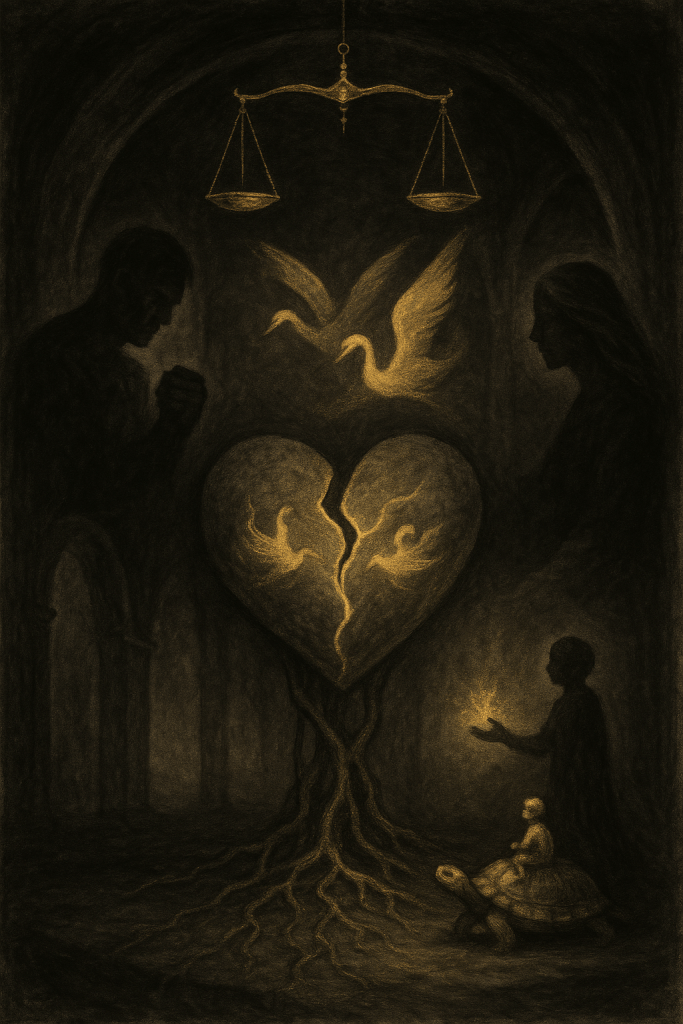
This is the line between genuine protection and weaponised alienation. Abuse and alienation are not opposites; they are twins in their effect. Both cut the child in half. Both make love a battlefield. Both leave scars on the soul.
And the objective task—though it feels almost impossible—is to discern not merely what happened in the marriage, but what is happening to the child now. Because the past, however tragic, is only part of the truth. The present reveals the fruit. If the child grows anxious, fractured, ashamed of love, then something poisonous is at work.
The duty of adults, then, is not to win. The duty is to contain the fracture. To say to the child, with action more than words: you need not choose between halves of yourself.
The Solomonic wisdom is still the same: the child’s wholeness must come before the parent’s victory. Always.
 Reade Saunders
Leave a comment