He is no longer just a man.
He is a diagram.
An intersection of roles:
Husband, Father, Stepfather, part-time Custodian, full-time Protector.
(Son?)
Keeper of calm, absorber of blame,
receiver of news after the fact.
He exists in margins—
between court orders and weekend bag zips,
between birthday cake and utility bills,
between the memory of how it started
and the gnawing truth of what it became.
Peterson once said that a father is
the one who takes responsibility voluntarily—
who stands at the edge of the known and the chaos,
and says: Here, I’ll carry that.
And so he does.
Even when no one thanks him.
Even when the children are taught to flinch
at the sound of his name in another house.
Even when his own mother turns her face
toward the mother of his children
and away from him,
as if this was a game with sides.
He knows that being a modern father means
you love children you didn’t create
and lose access to the ones you did.
That to be present is not just to attend
but to withstand.
You must remain soft enough to comfort
but hard enough to protect,
and not to break
when the bullets keep coming
day after day.
You must help with homework,
but on borrowed time.
You must learn to translate
the foreign dialect of read receipts and ‘neutral’ emails.
You must
just
Be there.
He used to think love was enough.
Now he knows providence must be scheduled,
transported in a car seat,
negotiated with barristers
and punctuated by handovers in supermarket car parks.
He does not always get it right.
Sometimes he can’t fight his sadness.
Sometimes he forgets that resentment
is just sorrow dressed in armour.
Sometimes, when he is alone,
which is rare,
He just sits
and stares.
But he also knows this:
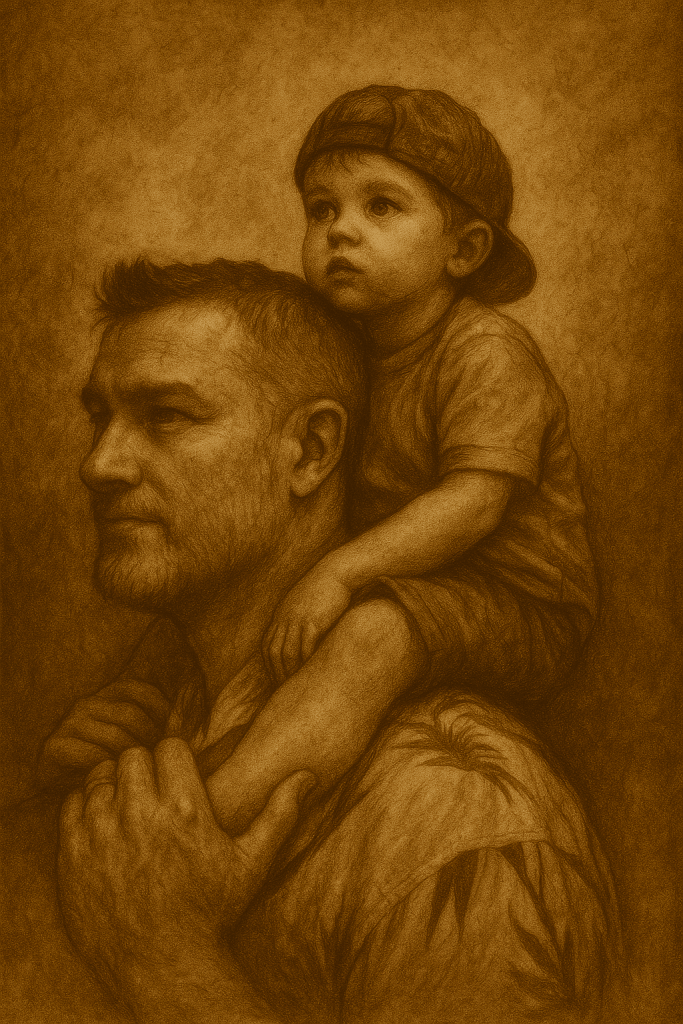
That when his son runs into his arms and buries his face
in his chest
as if coming home to oxygen,
that is real.
That when his stepdaughter sneaks into the kitchen
and asks him for noodles just the way she likes it—
because only he remembers—
that is a kind of miracle.
Pageau writes of patterns,
and he sees it now:
fatherhood is not just biology,
it is participation.
It is imitation of the divine.
To stand between chaos and order.
To absorb what others exhale.
He has become a harbour.
A scaffolding.
A mirror.
A memory.
And sometimes,
when no one is watching,
he allows himself this:
to believe he is doing well.
 Reade Saunders
Leave a comment