He does not cry when the door closes.
He has trained himself not to.
That training began when he was six,
when he wasn’t allowed
to bring his Easter egg home.
Now, at eight,
he sits up straight in the back seat of Mum’s car,
a Tesco bag rustling near his feet,
a hand-drawn Sonic scene in his lap.
He watches the steam fade from the glass
where his breath tried to write the word Dad
but stopped at D
because he didn’t want her to see.
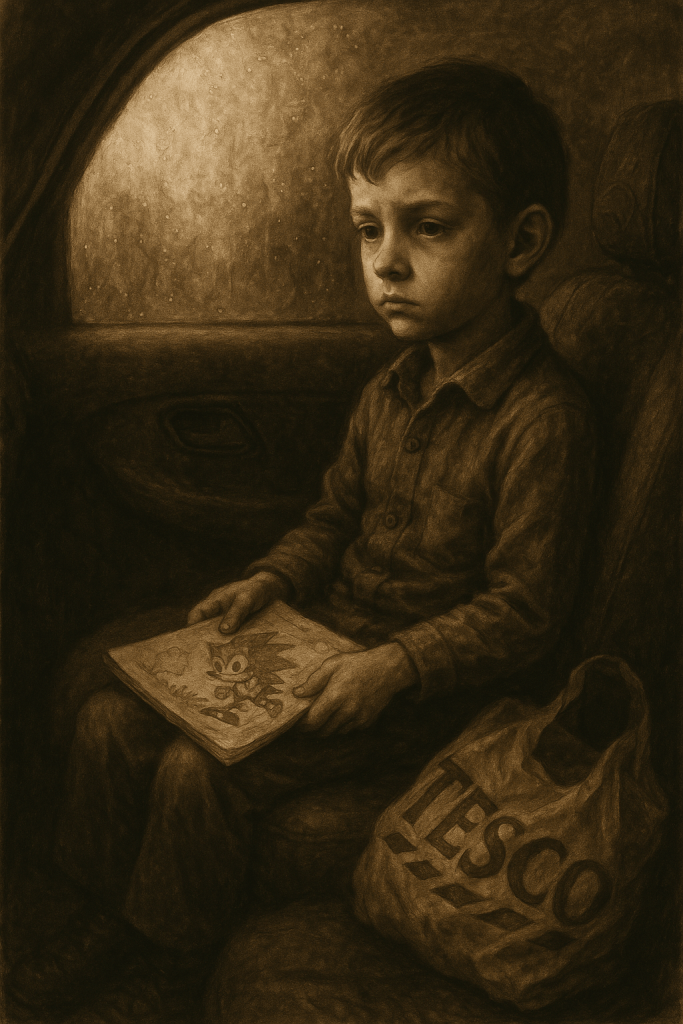
He is going back.
Back to the house with clean countertops
and closed doors.
Where calls to his father are
disruptive,
and silence
is repackaged as consistency.
His stomach hurts every Sunday.
Every single one.
The same way it did
when Dad showed up on the wrong day.
But instead of leaving,
the teacher let them sit in the art room
just the two of them
inking monsters with bright red mouths.
It was the best day.
And it became ammunition.
He knows she thinks she’s protecting him.
That’s what everyone says.
But protection shouldn’t feel like
shrinking.
At Dad’s house
he runs,
shouts,
wrestles.
He laughs like his chest can barely hold it.
He becomes large there.
Silly, loud, real.
But by Sunday
he is already folding inwards.
Preparing for the hush.
The whisper.
The change of air.
The version of him
he has to carry back like homework
he doesn’t understand.
At school,
they give him art therapy.
He draws wolves with three eyes
and trees with broken roots.
The lady with the kind voice asks what they mean.
He says,
They’re just trees.
He doesn’t ask to call.
She wouldn’t let him anyway.
He heard Grandma’s voice
in the kitchen last week.
Not in Dad’s house—
in Mum’s.
Whispering.
Together.
Alienation is not a word he knows.
But he feels it like cold hands
in warm pockets.
He just calls it
missing someone
and not being allowed
to say it out loud.
 Reade Saunders
Leave a comment